Participation in the C5+1 Ministerial Meeting, Samarkand
A record of the meetings held with international organisations, financial institutions and payment companies on 19 October 2026, and an assessment of the position arising from them.
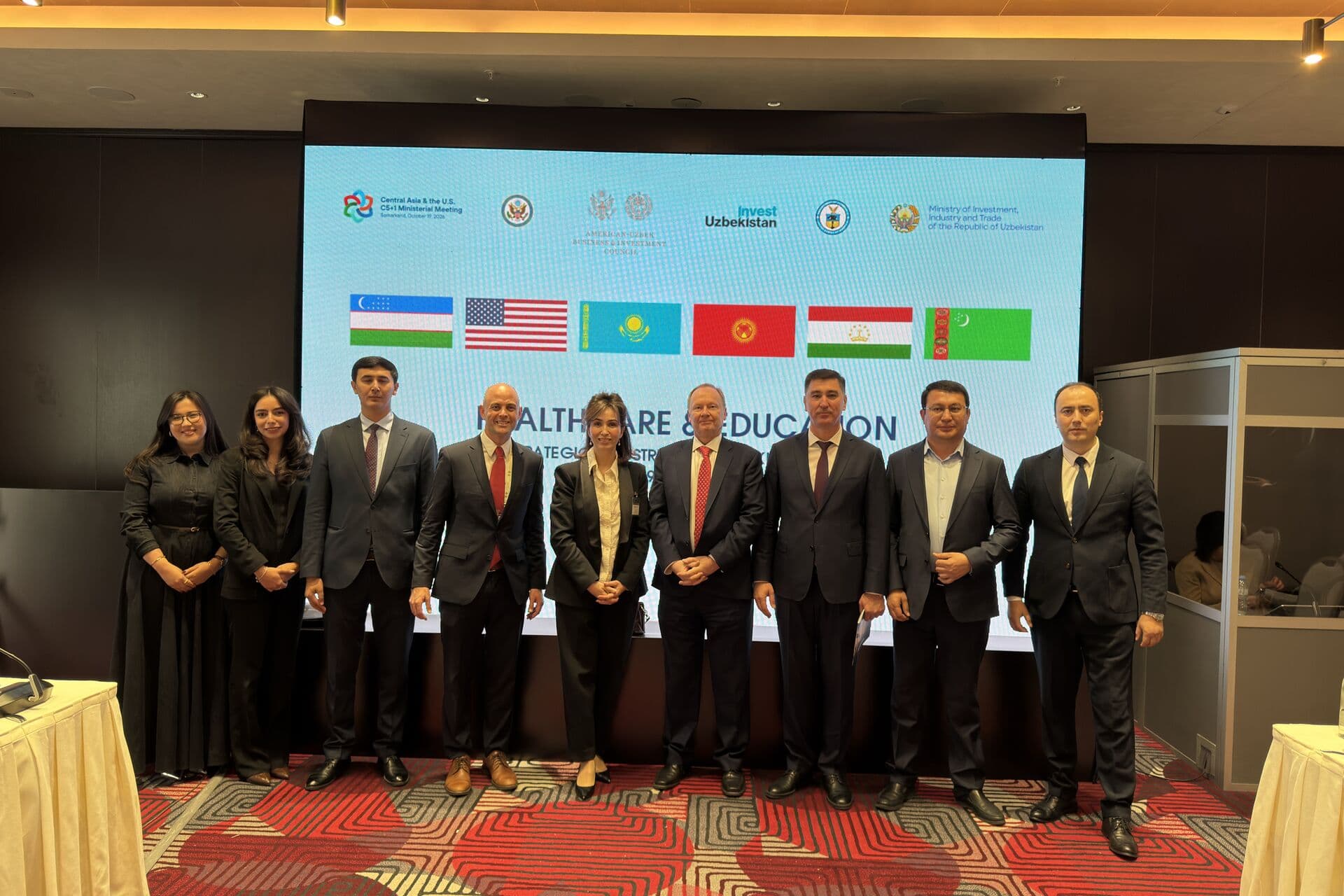
On 19 October 2026 the Ministerial Meeting of the C5+1 — the five states of Central Asia and the United States — convened in Samarkand. A business programme was held alongside the ministerial under the auspices of the American-Uzbek Business & Investment Council, Invest Uzbekistan, and the Ministry of Investment, Industry and Trade of the Republic of Uzbekistan.
I took part in that programme as a member of the visiting delegation, in my capacity as Senior Specialist in the Department of Business and Innovative Ideas of the Youth Entrepreneurship Development Fund. What follows is a record of the meetings held and the sessions attended, together with an assessment of the position arising from them.
1. Overview
The United States delegation was led by the Secretary of State, Marco Rubio, and was accompanied by the largest contingent of American companies yet to travel to the region. Published accounts of its size are not consistent with one another, and no figure is adopted here. Figures were likewise reported for the agreements concluded at state level. Those are properly treated as statements of intent, to be measured at conversion rather than at announcement.
2. Meetings held
In the course of the official visit, meetings were held with representatives of the following organisations.
| Organisation | Representative | Position |
|---|---|---|
| American Councils for International Education | Lisa Choate | President and Chief Executive Officer |
| Ipoteka Bank, OTP Group | Adam Szentpeteri | Chief Executive Officer |
| Office of Central Asian Affairs, Washington, D.C. | Carolyn Dubravsky | Director |
| Citibank | David Livingston | Chief Client Officer |
| Oppenheimer | Max Lami | Chief Executive Officer |
| Mastercard | Yasemin Esenlik | Vice President |
| Visa | Salima Gutieva | Cluster Manager |
| J.P. Morgan | Timur Kunanbayev | Managing Director, Head of Investment Banking |
The meetings were introductory in character. They served to establish professional contact and to exchange preliminary information. No commitments were entered into by any party, and none is to be inferred from this record.
3. Sessions attended
The delegation attended two thematic sessions, covering healthcare and education, and finance and investment respectively. Each was convened to address the issues of the sector concerned and to allow participating stakeholders to put their positions.
4. Assessment
The composition of the counterparties is more instructive than their number. Two payment networks, two American banks, an investment bank, a domestic institution under European ownership, an education body and an office of the United States Department of State. That composition is characteristic of a relationship at the stage of establishing infrastructure rather than of financing projects: payment rails, correspondent relationships and custody necessarily precede any larger undertaking that must be underwritten through them.
This is properly regarded as a sound position rather than a modest one. A market that proceeds directly to project finance without first establishing the underlying arrangements tends to generate announcements in place of transactions.
It is nevertheless necessary to state the position accurately. An introduction is not an obligation. An obligation has a counterparty, an instrument, an amount and a date; an introduction has none of these. The rate at which contacts established at occasions of this kind convert into executed business is, on any realistic assessment, low. That is not a criticism of the format — contact must be established before it can be acted upon — but it determines what responsible follow-up requires.
5. Indicators for subsequent review
The following are proposed as the measures against which the visit should be assessed over the next two quarters.
- Correspondent banking arrangements. Whether any United States institution opens or extends a line. This is the least conspicuous and most substantive indicator available, for the reason that it requires the approval of a compliance committee rather than the goodwill of a principal.
- Payment network licensing and domestic processing. Whether the networks proceed from representation to issued volume.
- Assignment of the agreements concluded. Whether undertakings entered into at state level are assigned to an identifiable balance sheet and a named obligor. Agreements that are not assigned are, in practice, agreements that lapse.
- Second meetings. The least ceremonial and most reliable of the four. A first meeting is a function of the occasion; a second is a function of interest.
6. Conclusion
Institutions that were not previously examining Uzbekistan are now doing so, and the seniority of those present indicates that the interest is substantive rather than formal. That constitutes a material change and is recorded as such.
It remains, as at the date of the visit, unconverted. The agreements concluded will be enumerated publicly in due course. The narrower question — how many of the contacts established survive examination by a credit committee — will not be answerable for a further twelve months.